
Get relief from tennis elbow pain
Tennis elbow is one of the most common causes of elbow pain — and the good news is, it responds extremely well to physiotherapy.
Whether your pain started from desk work, parenting, tennis, golf, hockey, or repetitive strain at work, our physiotherapists help you calm pain, rebuild tendon strength, and return to activity without flare-ups.
Treat the cause, not the symptom.
Get elbow pain relief


Do you have tennis elbow?
You might notice:
- Pain on the outside of your elbow
- Weak grip strength or forearm fatigue
- Pain when lifting, typing, twisting, or gripping
- Morning stiffness that eases once you “warm up”
Tennis elbow often builds slowly — and if left untreated, it can linger for months or even years. Early physiotherapy shortens recovery time and reduces the risk of recurrence.

What is tennis elbow?
Tennis elbow — clinically called lateral epicondylitis — happens when the tendons that attach to the outside of your elbow become overloaded.
These tendons work hard every time you grip, lift, type, or extend your wrist. Over time, repeated strain can exceed the tendon’s ability to recover, leading to pain, weakness, and reduced function.
Despite the name, most people with tennis elbow don’t play tennis. We commonly see it in:
- Desk-based parents and professionals
- Trades and manual work
- Racquet and stick sports (tennis, hockey)
- Golfers and throwing athletes

Tennis elbow vs golfer’s elbow vs pitcher’s elbow
Elbow pain isn’t one-size-fits-all. Accurate diagnosis matters.
- Tennis elbow – pain on the outside of the elbow
- Golfer’s elbow – pain on the inside of the elbow
- Pitcher’s / thrower’s elbow – pain from repetitive throwing or overhead stress
Each condition affects different tissues and requires a specific rehab plan, not generic exercises.
Can physiotherapy
help tennis elbow?
Yes, and the evidence is clear.
Research shows that structured physiotherapy:
✅ Reduces pain and disability
✅ Improves grip strength
✅ Outperforms “wait and see” approaches
✅ Matches or beats injections in long-term results
Why rest alone doesn’t work: Rest may temporarily reduce pain, but tendons need progressive loading to heal appropriately. Without it, pain often returns as soon as you resume regular activity.
Physiotherapy rebuilds your tendon’s capacity, so it stays better.
Patient feedback
Ask our customers
We’re proud to have earned 5-star reviews on Google from patients across Markham and Stouffville— see what they’re saying about their experience at The Physio Spot.


Book a physio to relieve your elbow pain


Experts who care
Meet your care team
Skilled professionals working together to help you move better.












What tennis elbow physiotherapy looks like at The Physio Spot
Tennis elbow treatments we may use
Targeted manual therapy
Hands-on treatment helps calm pain and restore normal movement in the elbow and surrounding joints. This may include soft tissue techniques and joint mobilizations to reduce stiffness, improve circulation, and ease protective muscle tension. Manual therapy isn’t a stand-alone fix, but it often makes movement and exercise more comfortable, especially in the early stages of recovery
Isometric and progressive loading exercises
We typically start with isometric exercises, where you activate the muscles without moving the joint. These exercises are gentle, pain-modulating, and help reintroduce load to the tendon safely. As your tolerance improves, we gradually increase the challenge to help your tendon adapt and regain strength.
Eccentric–concentric tendon rehab
As healing progresses, your program shifts to eccentric–concentric loading — controlled lengthening and shortening of the muscle-tendon unit. This type of training is one of the most effective ways to restore tendon capacity, grip strength, and resilience. Exercises are progressed carefully based on your symptoms, not a one-size-fits-all timeline.
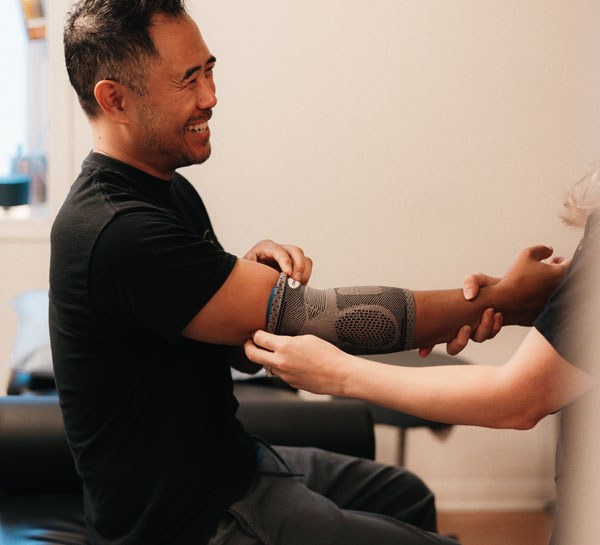
Taping or bracing
In some cases, taping or a counterforce brace can help reduce strain on the tendon and make daily tasks or exercise more manageable. These tools are used strategically to support movement and participation, not as long-term solutions. The goal is always to reduce reliance on external supports as your strength improves.
Ergonomic and activity coaching
Recovery doesn’t happen in the clinic alone. We help you adjust how you move at work, at home, and in sport. That might mean fine-tuning your desk setup, modifying lifting techniques, adjusting training volume, or changing how you grip equipment. Small changes can dramatically reduce tendon stress and prevent flare-ups.
Tennis elbow exercises (what works and what doesn’t)
You can find a variety of exercises to ease your elbow pain, but not all are created equal or tailored to your needs on your healing journey.

Why eccentric loading matters for tendon healing
Eccentric exercises, where you slowly lower a weight or resistance, have been shown to stimulate tendon adaptation and strength better than other types of exercise. This controlled lengthening creates the right stimulus for healing without overloading damaged tissue.
Importance of gradual progression
Your tendon needs time to adapt to increasing demands. Starting with exercises in a flexed elbow position and gradually progressing toward extension, then incrementally adding weight and functional tasks, allows your tendon to build capacity safely.
Why random online exercises can slow recovery
Generic exercise videos don’t account for your specific pain level, healing stage, work demands, or movement patterns. Doing too much too soon can aggravate your symptoms, while exercises that are too easy won’t provide the stimulus your tendon needs to strengthen. A physiotherapist ensures your program matches your current capacity and progresses appropriately.
What not to do with tennis elbow
Certain approaches can delay your recovery or make symptoms worse:
Don't push through sharp pain
Eccentric exercises, where you slowly lower a weight or resistance, have been shown to stimulate tendon adaptation and strength better than other types of exercise. This controlled lengthening creates the right stimulus for healing without overloading damaged tissue.
Avoid complete rest for long periods
While you should modify aggravating activities, complete inactivity allows your tendon to weaken and doesn’t prepare it for return to normal use. Appropriate, progressive loading is essential for recovery.
Don't rely on braces or bands alone
Tennis elbow braces and bands can provide temporary symptom relief and allow you to function better, but they don’t address the underlying weakness or poor mechanics that caused the problem. Use them as tools to support your rehabilitation, not as replacements for it.

How long does tennis elbow take to heal?
Recovery timelines vary depending on several factors, but most people see significant improvement within three to 12 weeks with guided physiotherapy.
- Factors that speed up recovery:
- Early treatment
- Good adherence to your exercise program
- Addressing ergonomic or technique issues
- Managing your workload appropriately all contributes to faster healing.
- Factors that delay recovery:
- Chronic symptoms that have been present for months or years
- Continuing high-demand activities without modification
- Poor exercise compliance
- Underlying factors, such as bilateral symptoms or work-related sensitization, can prolong recovery time.
The sooner you address tennis elbow, the less time the tendon spends in a weakened, irritable state. Early intervention prevents compensatory movement patterns and avoids the transition from acute to chronic pain.
Tennis elbow physiotherapy near you
Book tennis elbow physiotherapy
If you’re looking for elbow pain physiotherapy, choose a clinic that:
- Treats you one-on-one
- Focuses on exercise-based recovery
- Looks beyond the elbow to the whole movement system
That’s how lasting results happen.
The sooner you address it, the simpler the recovery becomes.


